We do not treat workforce strain, patient-safety risk, and performance problems as separate issues.
TPCO works beneath the visible symptoms to identify the conditions connecting them.
We examine how staffing, workload, technology, coordination, authority, leadership response, and hidden human compensation affect people, patient safety, and organisational performance.
Then we help leaders act on the conditions the system can actually change.
What this approach changes
When TPCO examines the conditions connecting workforce strain, patient-safety risk, and performance problems, leaders can see the system pattern beneath the symptoms.
That pattern may point to:
An inherited condition that once supported the work but no longer fits today's healthcare reality
A policy, process, technology, authority structure, or operating practice that now needs to be updated;
A condition that staff have repeatedly absorbed and normalised;
A local workaround that has protected care while concealing the underlying weakness.
When the pattern becomes visible, leaders can act closer to the source.
This helps the organisation avoid repeatedly adding surface-level interventions to a system that is already under strain. It also reduces the risk that staff will continue compensating through extra vigilance, informal coordination, skipped recovery, and workarounds.
Seeing the pattern allows leaders to address the source of repeated strain instead of asking the system to absorb more of it.
We examine how the work is actually functioning
Policies, procedures, dashboards, reporting systems, and formal workflows show how the work is expected to happen.
TPCO examines what people must do for the work to succeed under real conditions.
That includes:
Where people are compensating for gaps;
Where coordination depends on informal relationships;
Where information is delayed, softened, or contained;
Where workarounds have become routine;
Where responsibility exists without enough authority;
The Conditions Chain
We trace how conditions move through the system.
TPCO uses the Conditions Chain to examine how existing conditions shape perception and response, how responses enter the work, and how the resulting conditions affect participation, information flow, organisational visibility, learning, and performance.
It helps leaders move beyond a single event or metric and examine the connected pathway:
Conditions shape how people experience and respond to the work. Those responses affect what others must work inside. That influences what is raised, what becomes visible, what the organisation can learn, and how reliably it can perform.
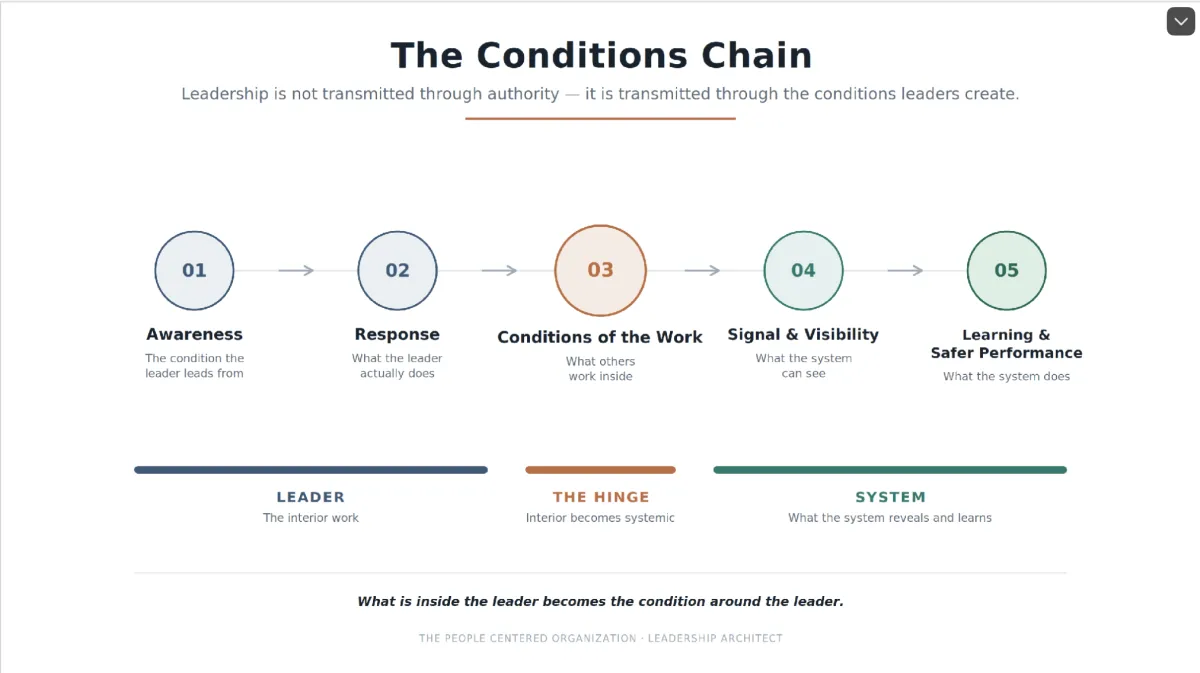
The Conditions Chain helps identify:
what the organisation has inherited;
where the current system no longer fits the reality of the work;
how people are adapting or compensating;
where important information weakens
where authority and accountability sit;
what may need to be preserved, updated, interrupted, or redesigned.
It does not replace patient safety, quality, compliance, reporting, governance, or improvement systems. It examines the conditions affecting whether those systems receive sufficiently candid, timely, complete, and actionable information from everyday work.
The Conditions Chain makes the system pattern visible so leaders can act closer to the source.
Leadership Architect
We help leaders see how their response becomes part of the conditions others must work inside.
The Conditions Chain makes the wider system pattern visible. Leadership Architect works the leader-facing part of that pattern.
It helps leaders examine how inherited conditions, role pressure, experience, assumptions, urgency, relationships, and incomplete information shape:
what they notice;
how they interpret what they hear;
how they respond;
what becomes possible or more difficult for others.
Leadership response affects whether concerns are explored or closed down, whether uncertainty can be admitted, whether people ask for help, whether important information moves, and whether the organisation learns from what becomes visible.
Leadership Architect does not assume leaders created the conditions they inherited. It helps them recognise what they are working inside, test whether their understanding is complete, and choose responses that reinforce, interrupt, or help reshape what others inherit next.
Leaders may not have created the system they inherited, but their response becomes part of the system moving forward.
We begin with a bounded pilot
TPCO usually begins with one team or one clearly defined area of work.
The purpose is not to fix the team.
The team provides a practical boundary through which the organisation can examine how wider system conditions are being experienced in everyday work.
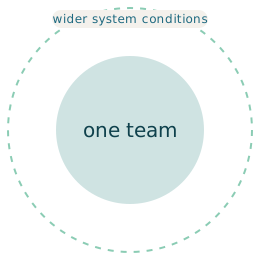
The pilot looks at:
what the work currently requires;
what people are compensating for;
which conditions originate locally and which are inherited from the wider organisation;
what becomes visible through formal systems;
what remains outside organisational visibility;
where authority for change sits;
which practical changes can be tested
without adding unnecessary burden.
This gives leaders a detailed, evidence-informed view of how the system is functioning before committing to a larger intervention.
The pilot may identify conditions that can be changed within the team. It may also reveal issues requiring action at department, executive, organisational, or system level.
We start small enough to see the work clearly, but wide enough to trace the conditions back to the level where change is possible.
What leaders receive
At the end of the pilot, leaders receive a decision-ready account of:
the conditions shaping the visible pattern;
what people are being required to absorb or compensate for;
what is becoming visible through current systems;
what may remain outside organisational visibility;
which conditions can be addressed locally;
which conditions require wider authority;
what was tested;
what changed;
what did not change;
what remains uncertain;
what the evidence supports doing next.
The goal is not to produce another report that sits outside the work.
The goal is to provide a clearer basis for action.
Clear scope. Responsible claims.
TPCO does not promise instant culture change, guaranteed patient-safety outcomes, or that one pilot can explain an entire organisation.
A bounded pilot may provide evidence about feasibility, implementation, local conditions, participant experience, information movement, organisational visibility, and what changed during the pilot period. It does not prove organisation-wide causation or guaranteed safer care.
The purpose is to provide an evidence-informed view of how conditions are affecting the work and support a better next decision.
Learn more about the pilot
For organisations considering a pilot, TPCO provides a detailed PDF outlining: what the organisation has inherited;
where the current system no longer fits the reality of the work;
how people are adapting or compensating;
where important information weakens
where authority and accountability sit;
what may need to be preserved, updated, interrupted, or redesigned.
Begin with a strategic conversation
Every engagement begins with a focused working session—not a sales presentation.
Together, we determine whether the problem, sponsorship, scope, authority, and readiness are right for the work.
