We help healthcare organisations see the conditions beneath the problems they are trying to solve.
The People Centered Organization works at the intersection of workforce experience, patient safety, quality, governance, and operational performance.
Healthcare leaders are often asked to address burnout, turnover, communication failures, safety concerns, recurring workarounds, and performance pressure as separate problems. TPCO helps organizations look further upstream—at the conditions connecting those patterns and shaping how the work is actually carried out.
We examine what people are being required to absorb, what remains outside organizational visibility, where authority for change sits, and whether apparently stable performance depends on hidden human effort.
Our purpose is not to introduce another disconnected initiative. It is to help healthcare organizations understand and strengthen the conditions that support their workforce, improve the visibility of risk and operating reality, and make safer, more reliable performance more possible.
Why TPCO was built
TPCO began with psychological safety.
When I first entered this work as a psychological safety practitioner, the team was the center of attention. We measured whether people felt able to speak openly, ask for help, discuss mistakes, disagree, and raise concerns.
But the work revealed something deeper.
A team could participate in the process. A leader could receive the results. People could better understand the patterns affecting communication and participation. Yet the conditions surrounding the work often remained unchanged.
The staffing pressure remained. The workload remained. The technology, policies, priorities, authority boundaries, coordination demands, and organisational responses remained. The team was still being asked to perform inside conditions created and sustained at the wider system level.
I realised that psychological safety measurement was not always the intervention the organisation needed. A team cannot change conditions that sit beyond its authority.
That realisation became the foundation of TPCO.
Healthcare is complex, uncertain, interdependent, and high pressure. That is not an exception to the work; it is part of the everyday reality of care. People who enter healthcare understand that this is not an ordinary job. The work carries emotional weight, professional responsibility, and serious consequences when information is missed, coordination fails, or an error reaches a patient.
Healthcare's safety, quality, governance, and compliance systems exist for good reason. They are intended to protect patients, support accountability, reduce preventable harm, and help organisations operate reliably.
TPCO does not seek to replace those systems.
We examine the conditions they create and operate within—and how those conditions affect the people doing the work, the information the organisation receives, and the outcomes it is trying to achieve.
Our work asks:
What conditions is the system creating, how are people being affected by those conditions, and what must change to better support the work?
That is the origin of TPCO and the reason we work beyond the surface level.
What we believe
People are not the problem.
They work inside conditions shaped by staffing, workload, technology, policy, priorities, authority, relationships, history, and leadership response. Those conditions influence what people can sustain, what they notice, what they raise, how they respond, and what the organisation is ultimately able to see.
Leaders and staff often inherit conditions they did not create. Everyone participates in how those conditions are reinforced, altered, interrupted, or carried forward, but not everyone has equal power to change them.
That is why TPCO does not begin with blame.
We examine what the work requires, what choices were realistically available, where authority sits, what people are being asked to compensate for, and how the system is affecting both behaviour and outcomes.
A systems explanation does not remove accountability. It makes accountability more accurate by connecting responsibility to authority, conditions, decisions, and consequences.
Our work is grounded in a simple belief:
When organizations make the conditions of the work visible, they can respond more accurately to the people, risks, and outcomes those conditions are shaping.
How we think and learn
Our work is grounded in systems thinking and informed by
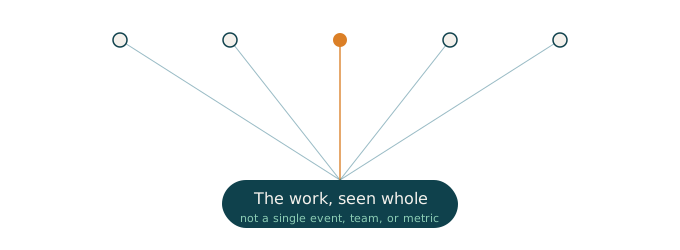
Together, these perspectives help us look beyond a single event, individual, team, or metric. They help us examine how structures, relationships, history, authority, uncertainty, human experience, and everyday responses interact across the organisation.
We do not treat any framework as a complete answer. We use each as a disciplined lens—testing what it helps us see, where its boundaries sit, and whether it fits the reality of the organisation and the work.
TPCO remains in learning mode. We continue to study, question our assumptions, test our thinking, and challenge established approaches when they no longer adequately explain what people are experiencing or what the system requires. Our methodology is designed to develop through responsible inquiry, evidence, practice, and reflection—not through certainty for its own sake.
We also recognise that no two healthcare organisations are the same. Each has been shaped by the people, decisions, pressures, relationships, successes, and lessons that came before. We do not enter assuming that the past was wrong or that the organisation must be rebuilt from the ground up.
We begin by respecting what has already been carried forward.
Our role is to help the organisation understand what it has inherited, preserve what continues to serve the work, and strengthen the conditions required for what comes next.
Because healthcare organisations do not affect only the people who work inside them. The conditions they create reach patients, families, communities, and the future workforce that will inherit the system next.
What makes TPCO different
We do not begin with a predetermined solution.
We do not treat burnout, turnover, communication failures, safety events, quality concerns, and compliance pressures as isolated problems.
We connect workforce experience, patient safety, quality, governance, and operational performance.
We examine work as it is actually done, not only how policy says it should occur.
We distinguish formal data from complete organisational visibility.
We identify where the system may be relying on hidden human compensation to sustain performance.
We do not assign responsibility for changing conditions to people or teams who do not hold the authority to change them.
We complement existing healthcare safety, quality, reporting, compliance, governance, and improvement systems rather than replacing them.
Clients can expect TPCO to work with:
No blame-first interpretation
Transparent scope and evidence boundaries
Respect for confidentiality, privacy, and individual protections
Respect for healthcare expertise and local authority
Attention to burden, workflow, and operational reality
Clear distinction between what is known, inferred, tested, and still uncertain
No promises of instant culture change or guaranteed patient-safety outcomes
A willingness to challenge our own assumptions as the work develops
Our Foundations
TPCO's work is informed by professional study and practice in psychological safety, systems thinking, leadership development, organisational change, behavioural assessment, and complex-work facilitation.
Our foundations include the Fearless Organisation Scan, Predictive Index, VUCA facilitation, Theory U, Intentional Change Theory, Emotional Agility, and the continued development of TPCO's own Conditions Chain, Leadership Architect, and Conditions for Safer Care methodologies.
These foundations do not operate as a collection of disconnected tools. They help us examine the system from multiple angles while keeping the work anchored in the conditions people are actually working inside.
Carrying the work forward
Healthcare organizations are built on the work, decisions, sacrifices, and learning of those who came before.
TPCO's role is not to erase that history. It is to help organisations understand what they have inherited, preserve what continues to serve the work, strengthen the conditions required now, and carry the organisation forward in a way that better supports people, patients, and communities.
